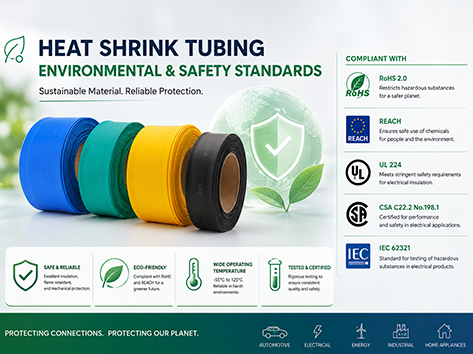
Environmental and Safety Standards for Heat Shrink Tubes Explained
ভূমিকা
Heat shrink tubes are widely used in electrical insulation, cable protection, automotive wiring, telecommunications, renewable energy systems, and industrial equipment. As industries place greater emphasis on safety, environmental protection, and product reliability, manufacturers and buyers must ensure that heat shrink tubing complies with international environmental and safety standards.
Understanding these standards is essential for selecting high-quality heat shrink products that meet regulatory requirements and ensure long-term performance in demanding applications.
What Are Heat Shrink Tubes?
Heat shrink tubes are polymer-based insulating sleeves that shrink when heated, creating a tight protective covering around wires, connectors, terminals, and cable assemblies.
Their main functions include:
বৈদ্যুতিক নিরোধক
Mechanical protection
Waterproof sealing
Corrosion resistance
Cable organization
Strain relief
Because heat shrink tubing is often used in critical electrical systems, compliance with industry standards is extremely important.
Why Environmental and Safety Standards Matter
Heat shrink tubes are frequently installed in environments where electrical safety and fire prevention are essential. Poor-quality tubing may lead to:
Electrical failure
Short circuits
Fire hazards
Toxic smoke emissions
Premature aging
Environmental pollution
Compliance with international standards helps ensure:
Product safety
Stable insulation performance
Environmental protection
Reliability in harsh conditions
Legal market access
For manufacturers, meeting these standards also improves product credibility and competitiveness in global markets.
Key Environmental and Safety Standards for Heat Shrink Tubes
UL Certification (Underwriters Laboratories)
UL certification is one of the most recognized safety standards for electrical products.
Heat shrink tubing with UL certification has been tested for:
শিখা প্রতিরোধের
Electrical insulation performance
Heat resistance
Mechanical durability
UL-certified heat shrink tubes are commonly used in:
Consumer electronics
Industrial equipment
Automotive wiring
Power systems
Many buyers specifically require UL-approved heat shrink tubing to ensure compliance with electrical safety regulations.
RoHS Compliance
RoHS stands for Restriction of Hazardous Substances.
This environmental regulation restricts the use of hazardous materials such as:
Lead (Pb)
Mercury (Hg)
Cadmium (Cd)
Hexavalent chromium (Cr6+)
Certain flame retardants
RoHS-compliant heat shrink tubes are safer for both users and the environment.
RoHS compliance is especially important for products exported to:
European Union countries
Consumer electronics markets
Medical equipment industries
Today, most high-quality heat shrink tubing manufacturers produce RoHS-compliant products.
REACH Regulation
REACH is a European Union regulation concerning the safe use of chemicals.
The regulation focuses on controlling substances that may pose risks to:
Human health
Environmental safety
Heat shrink tubing manufacturers must ensure their materials do not contain excessive levels of harmful chemicals listed under REACH regulations.
REACH compliance is increasingly required in international supply chains.
Halogen-Free Standards
Traditional plastic materials may release toxic gases during combustion. Halogen-free heat shrink tubing is designed to reduce toxic smoke and corrosive gas emissions during fire incidents.
Halogen-free tubing is widely used in:
Rail transportation
Data centers
Public buildings
Smart infrastructure
Electric vehicles
Advantages include:
Lower smoke density
Reduced toxicity
Improved fire safety
Better environmental performance
As global safety standards become stricter, halogen-free heat shrink tubes are becoming increasingly popular.
Flame Retardant Standards
Flame-retardant performance is critical in electrical insulation products.
Common flame-retardant standards include:
UL VW-1
This standard tests whether the tubing can self-extinguish after exposure to flame.
IEC 60695
International standard for fire hazard testing of electrical materials.
CSA Standards
Canadian electrical safety certifications related to flame resistance and insulation safety.
Flame-retardant heat shrink tubing helps prevent fire spread in electrical systems.
IEC Standards (International Electrotechnical Commission)
IEC standards are globally recognized standards for electrical products and systems.
Relevant IEC standards for heat shrink tubing may include requirements for:
বৈদ্যুতিক নিরোধক
Voltage resistance
Thermal aging
যান্ত্রিক শক্তি
Environmental resistance
IEC-compliant products are commonly used in:
Industrial automation
পুনর্নবীকরণযোগ্য শক্তি সিস্টেম
Power distribution
Telecommunications
Automotive Industry Standards
Automotive electrical systems operate under demanding conditions involving:
High temperatures
Vibration
Chemicals
Moisture exposure
Automotive-grade heat shrink tubing may comply with standards such as:
SAE standards
ISO automotive standards
OEM-specific requirements
These standards ensure reliable long-term performance in vehicle wiring systems.
Military and Aerospace Standards
In aerospace and defense industries, heat shrink tubing must meet extremely strict safety and durability requirements.
Military-grade tubing is designed for:
Extreme temperatures
Chemical resistance
Radiation resistance
High mechanical durability
Common standards include:
MIL specifications
Aerospace material standards
These applications require the highest level of reliability and quality control.
Important Performance Requirements for Heat Shrink Tubes
Beyond certifications, several performance factors are critical when evaluating heat shrink tubing.
বৈদ্যুতিক নিরোধক কর্মক্ষমতা
Good insulation prevents:
Electrical leakage
Short circuits
Equipment damage
Higher dielectric strength improves operational safety.
Temperature Resistance
Heat shrink tubes must withstand both high and low operating temperatures without cracking or degrading.
Chemical Resistance
Industrial and automotive applications may expose tubing to:
Oils
Fuels
Solvents
Cleaning chemicals
Chemical-resistant materials improve service life.
UV and Weather Resistance
Outdoor electrical systems require protection against:
Sunlight
Rain
Humidity
Salt spray
UV-resistant tubing is essential for renewable energy and telecommunications applications.
Future Trends in Environmental and Safety Standards
As global environmental awareness grows, future heat shrink tube standards will likely focus on:
Lower carbon emissions
Recyclable materials
Enhanced fire safety
Non-toxic flame retardants
Sustainable manufacturing processes
Smart electrical systems and electric vehicles are also increasing demand for higher-performance insulation materials.
Manufacturers that invest in environmentally friendly and safety-certified products will have stronger competitiveness in international markets.
উপসংহার
Environmental and safety standards play a critical role in ensuring the quality, reliability, and compliance of heat shrink tubes used in modern electrical systems.
Standards such as UL, RoHS, REACH, IEC, and halogen-free certifications help guarantee that heat shrink tubing can provide safe insulation, fire resistance, environmental protection, and long-term durability.
As industries continue to prioritize sustainability and electrical safety, high-quality certified heat shrink tubing will become even more important across electronics, automotive, renewable energy, and industrial applications.
FAQ
Why is UL certification important for heat shrink tubing?
UL certification verifies that the tubing meets recognized electrical safety and flame-retardant standards.
What does RoHS compliance mean?
RoHS compliance means the product restricts the use of hazardous substances such as lead and mercury.
What are halogen-free heat shrink tubes?
They are tubing products designed to produce lower toxic smoke and corrosive gases during combustion.
Why are flame-retardant standards important?
They help reduce fire risks and improve electrical system safety.
Which industries require certified heat shrink tubing?
Electronics, automotive, aerospace, telecommunications, renewable energy, and industrial automation industries commonly require certified products.
--- শেষ ---
 ই-মেইল: [email protected]
 নং 20 লিঙ্গিউন রোড, ডংফেং
ইন্ডাস্ট্রিয়াল জোন, লিউশি টাউন, ইউকিং
শহর, ঝেজিয়াং প্রদেশ

হোয়াটসঅ্যাপ

© কপিরাইট 2024 China Haitan Electromechanical Technology Co., Ltd. সর্বস্বত্ব সংরক্ষিত৷দ্বারা সমর্থন: JUNJ গোপনীয়তা নীতি
 Bengali
  English (United States)
  English (South Africa)
  Arabic
  Belarusian
  Japanese
  Kazakh
  Korean
  Myanmar
  Russian
  Thai
Thai  Ukrainian
  Uzbek
Uzbek  Vietnamese
  Chinese