
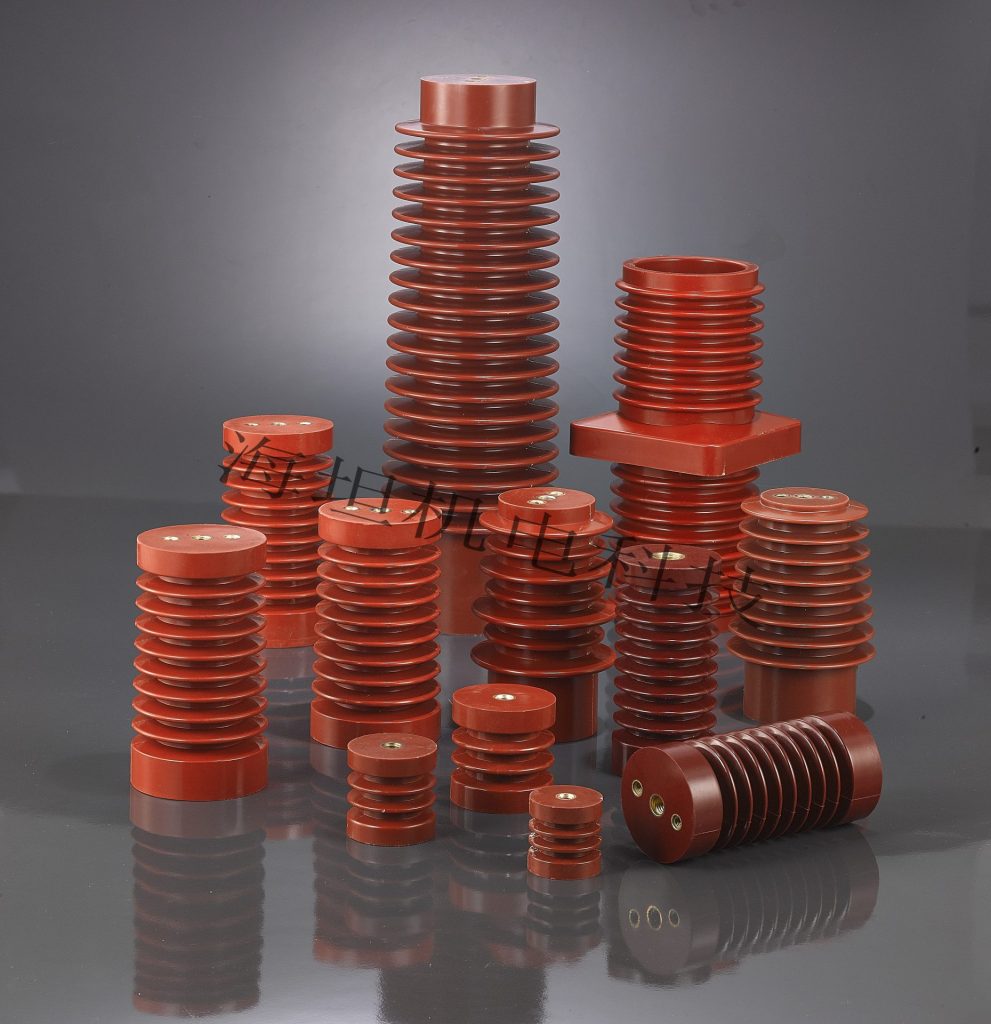
Busbar Support Insulators for Switchgear & Distribution Panels
Қожалдама | Жаңалықтар | Сен 01,2026
Every switchgear cabinet and distribution panel has the same basic problem to solve: copper or aluminum busbars carry current at close range to each other and to the enclosure itself, and something has to keep those conductors physically separated and electrically isolated without failing under heat, vibration, or years of continuous load. That “something” is the busbar support insulator — a component your team probably specifies without much drama when it works, and thinks about constantly when it doesn’t.
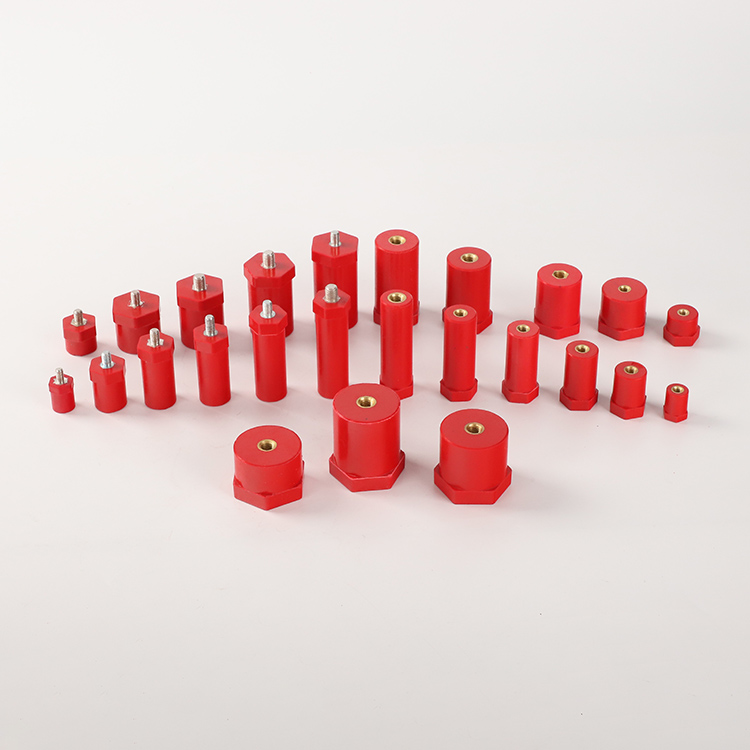
This guide covers what a busbar support insulator actually needs to do inside a switchgear or distribution panel, which material and mounting properties matter most for long-term reliability, and how standoff-style and frame-style designs fit different panel layouts.
What a Busbar Support Insulator Actually Does
A busbar support insulator has two jobs running at once, and both matter equally. Electrically, it separates live conductors from each other and from grounded surfaces, preventing phase-to-phase faults, short circuits, and arcing between busbars that are often mounted just centimeters apart. Mechanically, it holds those busbars firmly in place against vibration, thermal expansion and contraction, and the mechanical stress that occurs during a fault current event — a moment when the forces on a busbar can spike dramatically for a fraction of a second.
Lose either function and you have a problem: an insulator that holds a busbar securely but degrades electrically becomes a tracking risk, while one with good dielectric properties but poor mechanical strength can loosen or crack under normal operating vibration, eventually letting busbars shift out of their intended spacing.
Why Material Choice Drives Long-Term Reliability
Engineers specifying busbar support insulators are typically choosing between a handful of established materials — porcelain, epoxy resin, nylon, and compression-molded composites like BMC and SMC — and each comes with real trade-offs rather than one universally correct answer. Porcelain has a long track record in substations and high-voltage work, with excellent dielectric strength and weathering resistance, but it’s heavy, brittle, and unforgiving of impact. Nylon and standard thermoplastics are lightweight and inexpensive but tend to lag behind thermoset composites on heat resistance and long-term dimensional stability under load.
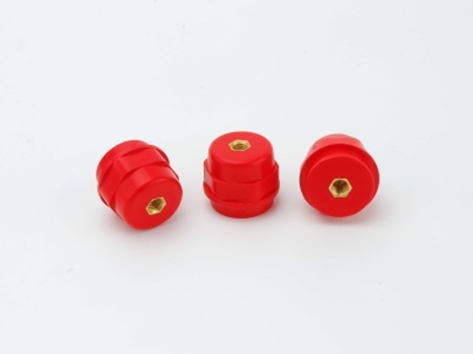
BMC and SMC composites — glass-fiber reinforced, compression-molded thermosets — have become a common middle ground for low voltage switchgear and distribution panel applications specifically because their thermoset chemistry resists heat and deformation better than standard plastics, while remaining considerably lighter and less brittle than porcelain. That combination is a large part of why they show up so consistently across standoff insulators, bus support frames, and compact high-strength insulators used in modern panel designs.
Comparing insulator materials for your next panel design?
Performance Properties Worth Verifying Before You Specify
Beyond the base material, a few specific properties determine whether an insulator will actually hold up in service rather than just on a datasheet:
- Heat resistance: Panels generate continuous background heat from normal current flow, and thermoset composites like BMC/SMC are valued precisely because their molecular structure doesn’t soften or deform under sustained thermal load the way standard plastics can.
- Dielectric strength: This is what actually prevents arcing and short circuits between conductors — it’s the electrical property doing the safety work, more than the voltage rating printed on the box.
- Moisture absorption: Composite insulators with low moisture uptake maintain more consistent electrical performance across humid conditions than materials that absorb and hold water, since moisture ingress is a common driver of degraded insulation resistance over time.
- Mechanical strength and dimensional tolerance: Especially relevant for busbar spacing accuracy — tighter height and dimensional tolerances mean more predictable creepage and clearance distances across a full production run, not just on the first sample.
- Fire performance: A UL94 V0 rating indicates the material self-extinguishes quickly if ignited, which matters inside an enclosed panel where a fault could otherwise become a fire risk.
Standoff, Frame, and Compact Designs: Matching Structure to Panel Layout
Not every busbar support insulator looks the same, because not every panel layout needs the same thing. A SM standoff insulator is a spindle-shaped design with a raised center section for wrench installation — a straightforward, widely used format for distribution boxes, switchgear, inverters, and general panel work. Bus support frame insulators take a different approach, spanning and supporting single-phase, three-phase, four-phase, or even five-phase busbar arrangements within one structure, which suits panels where multiple conductors need to be held in fixed relative position to each other rather than mounted individually.
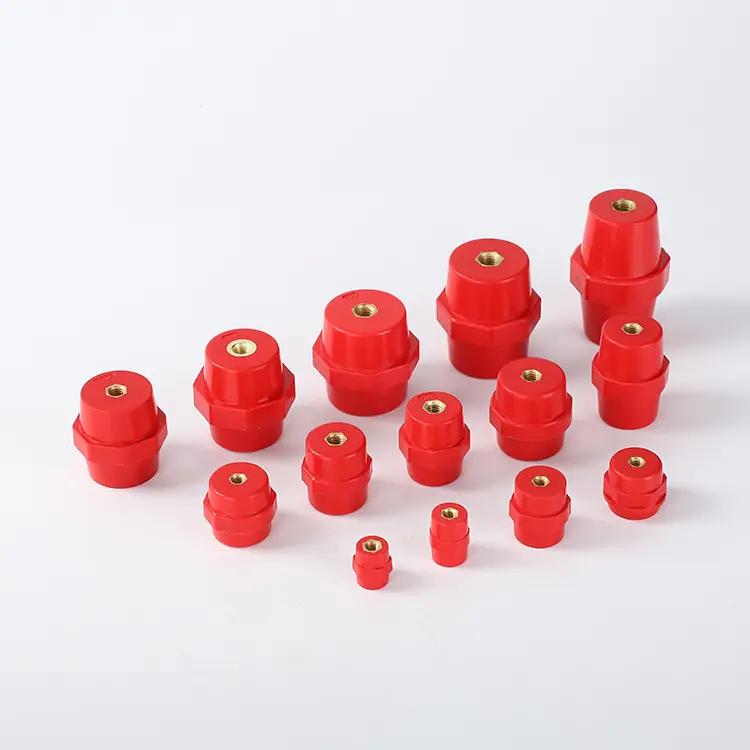
The SB series takes the same base material into a more compact, higher-strength format, developed for space-constrained applications like electric vehicle battery packs, 5G communication cabinets, and charging piles — environments where panel real estate is limited but mechanical demands haven’t gotten any lighter. If your project mixes conventional distribution panels with newer high-density equipment, it’s worth checking the BMC/SMC SB Series alongside standard standoff options rather than assuming one format fits both use cases.
| Design Type | Structural Approach | Best Fit For |
|---|---|---|
| Standoff (SM-style) | Single spindle, wrench-installed, raised center section | Individual busbar mounting in distribution boxes, inverters, general panels |
| Bus support frame | Spans multiple busbars in fixed relative position | Multi-phase busbar systems, switchgear |
| Compact high-strength (SB-style) | Smaller footprint, reinforced mechanical rating | EV battery packs, 5G cabinets, charging infrastructure |
Where Busbar Support Insulators Show Up in Real Systems
Across the industry, busbar support insulators are specified wherever conductors need both isolation and physical support in close quarters: phase separation inside low and medium voltage switchgear, secure busbar mounting in distribution boards, mechanical and electrical isolation of conductors in substation equipment, vibration and UV resistance for renewable energy installations exposed outdoors, and chemical-resistant applications in industrial plants with corrosive atmospheres. The common thread across all of these is the same two-part job described earlier — hold the conductor exactly where it needs to be, and keep it electrically separate from everything around it.
What to Ask For Before You Finalize a Selection
A datasheet claim of “heat resistant” or “high strength” is only useful if it’s backed by something you can check. Ask for the specific operating temperature range the insulator is rated for, the certifications that apply to the exact product (CE, RoHS, UL94, and relevant national marks like CQC or CCC), and whether dimensional tolerances are held consistently across production runs rather than just on sample units. For any application with meaningful vibration or fault-current exposure — heavy industrial equipment, EV charging infrastructure, or outdoor renewable energy installations — it’s also worth confirming what mechanical load testing was performed and under what conditions.
Need documented specs for your switchgear or panel project?
ЖҚС
What’s the difference between a standoff insulator and a bus support frame insulator?
A standoff insulator typically mounts and supports a single busbar at a fixed height. A bus support frame spans and holds multiple busbars — single, three, four, or five-phase — in fixed relative position within the same structure, which suits panels with more complex multi-phase layouts.
Are BMC/SMC insulators suitable for copper and aluminum busbars alike?
Yes. The insulator’s material properties relate to its own electrical and mechanical performance rather than the conductor metal — BMC/SMC insulators are used with both copper and aluminum busbars across standard low voltage panel applications.
How does moisture resistance actually affect long-term performance?
Materials that absorb moisture tend to see their dielectric properties shift over time, especially in humid or outdoor environments. Composite insulators with lower moisture uptake maintain more consistent electrical performance across seasonal humidity changes than materials that readily absorb water.
What does a UL94 V0 rating actually tell me?
It indicates the material passed a standardized vertical burn test and self-extinguishes quickly without flaming drips. For enclosed panel applications, this is one of the more relevant fire-safety data points to check on a datasheet.
Can insulator color or finish be customized for branding or identification purposes?
Some standoff insulator designs offer customizable color options, which can be useful for phase identification or matching panel branding standards. Confirm customization options and any related minimum order requirements directly with your supplier.
Why do compact, high-strength insulators matter for EV and 5G applications specifically?
These applications typically have less available panel space than conventional distribution equipment but still carry meaningful mechanical and electrical demands, which is why compact high-strength formats were developed — to meet the same isolation and support requirements in a smaller footprint.
Do all busbar support insulators need the same certifications?
Not necessarily — required certifications depend on your project’s region, industry, and application. CE and RoHS are common baseline requirements for many markets, while specific industries or export destinations may require additional national or product-specific certifications.
Reliable isolation and support for your next switchgear or panel build.
--- СОҢЫ ---
 E-mail: [email protected]
  №20 Лингюн жол, донгфенг
Индустриалды аймақ, Лиуши қаласы, YueQing
Қалалық, Жезеген провинциясы


Махат
© Copyright 2024 China Haitan электромеханикалық технологиясы Co., Ltd. Барлық құқықтар қорғалған.Қолдау: junj Құпиялылық саясаты
 Kazakh
  English (United States)
  English (South Africa)
  Arabic
  Belarusian
  Bengali
  Japanese
  Korean
  Myanmar
  Russian
  Thai
Thai  Ukrainian
  Uzbek
Uzbek  Vietnamese
  Chinese