Copper Ground Bar Thickness and Current Carrying Capacity Guide
소개
Copper ground bars are critical components in electrical panels and low-voltage distribution systems. They provide a reliable path for fault currents and ensure electrical safety for equipment and personnel. Selecting the correct thickness and current carrying capacity of a copper ground bar is essential for efficient and safe grounding. This guide explains how to choose the right copper ground bar based on thickness, cross-sectional area, and load requirements.
What Is a Copper Ground Bar?
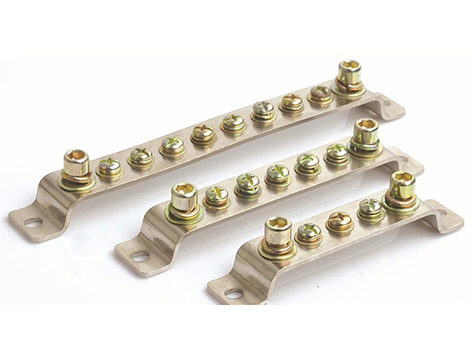
에이 구리 접지 바 is a conductive busbar made of copper, used to connect multiple grounding conductors in an electrical panel or system. It provides a single, low-resistance path to the ground, ensuring:
Electrical safety for equipment and personnel
Stable reference potential for the system
Effective dissipation of fault currents
Copper is chosen due to its high electrical conductivity, corrosion resistance, and mechanical strength.
Why Thickness Matters
그만큼 thickness of a 구리 접지 바 directly affects:
Current carrying capacity – Thicker bars can safely carry more fault current without overheating.
기계적 강도 – Thicker bars provide better durability and support for multiple connected cables.
Voltage drop – Adequate thickness ensures minimal voltage drop across the bar during fault conditions.
Using a bar that is too thin can cause overheating, excessive voltage drop, or even system failure, while over-sizing increases cost unnecessarily.
Copper Ground Bar Current Carrying Capacity
그만큼 current carrying capacity of a copper ground bar depends on:
Bar thickness and width (cross-sectional area)
Length of the bar
Number of connected conductors
Ambient temperature
Type of installation (enclosed panel vs open air)
Typical Guidelines
| Copper Bar Thickness | Width | Approx. Cross-Section
(mm²) |
Current Capacity
(A) |
Notes |
| 3 mm | 20 mm | 60 | 100–125 | Light-duty panels |
| 5 mm | 25 mm | 125 | 150–200 | Standard industrial panels |
| 6 mm | 30 mm | 180 | 200~250 | Heavy-duty distribution |
| 8 mm | 40 mm | 320 | 300~400 | High-current applications |
| 10 mm | 50 mm | 500 | 400–500+ | Large industrial or renewable energy panels |
Note: Values are approximate. Always refer to IEC 60947, NEC, or local standards for precise sizing based on temperature, fault current, and installation conditions.
Other Factors Affecting Copper Ground Bar Selection
Tinned vs Bare Copper – Tinned copper resists corrosion in humid or outdoor environments.
Number of Terminations – More connected cables require a thicker or wider bar to prevent localized overheating.
Panel Layout – Ensure sufficient clearance around the bar for heat dissipation.
Fault Current Rating – Check maximum expected short-circuit current to ensure the bar can safely handle it.
설치 팁
사용 proper torque on terminal screws to ensure secure connections without damaging the bar.
Avoid sharp bends in the copper bar; keep connections straight for minimal resistance.
Label and color-code ground bars when multiple phases or systems are involved.
For modular panels, ensure bar thickness is compatible with DIN Rail and terminal blocks.
결론
Choosing the correct thickness and current carrying capacity of a 구리 접지 바 is critical for electrical safety, reliability, and long-term performance. By considering cross-sectional area, number of connections, environmental conditions, and expected fault currents, engineers and panel builders can ensure efficient grounding and system protection.
Using standardized guidelines and following IEC, NEC, or UL recommendations ensures that copper ground bars perform reliably in industrial, commercial, and renewable energy applications.
FAQ
What thickness of copper ground bar should I use for my electrical panel?
The required thickness depends on the current carrying capacity, number of connected cables, and fault current rating. Typical industrial panels use copper bars between 3 mm and 10 mm thickness, with wider bars needed for higher currents or multiple connections.
How does the thickness of a copper ground bar affect current carrying capacity?
Thicker copper ground bars have a larger cross-sectional area, which reduces resistance, minimizes voltage drop, and allows the bar to safely carry higher fault currents without overheating.
Can I use a thin copper bar for heavy-duty applications?
No. Using a bar that is too thin can result in overheating, excessive voltage drop, or damage during a fault. Always calculate current requirements and select a bar thickness that meets or exceeds the maximum expected load.
What is the difference between tinned and bare copper ground bars?
Tinned copper: Offers better corrosion resistance in humid, marine, or outdoor environments.
Bare copper: Provides slightly lower cost and slightly higher conductivity but is more susceptible to oxidation over time.
How do I calculate the current carrying capacity of a copper ground bar?
Consider these factors:
Bar thickness and width (cross-sectional area)
Number of connected conductors
Ambient temperature
Installation type (enclosed panel vs open air)
Refer to IEC, NEC, or UL guidelines for precise sizing.
Can a copper ground bar carry the same current as a conductor?
Copper ground bars are designed for fault and grounding currents, not continuous high-load currents like conductors. Always ensure the bar is sized based on maximum fault current and system requirements, not just continuous operating current.
How should I install a copper ground bar safely?
사용 proper torque on screws to avoid damage
Avoid sharp bends; keep bars straight for low resistance
보장하다 adequate clearance for heat dissipation
Label bars and terminals for easy identification
Can I use the same copper ground bar for multiple panels?
Yes, but ensure the bar’s thickness and width can handle the combined current and number of connections. Large systems may require multiple bars or busbar interconnections to distribute fault current safely.
--- 끝 ---
 이메일: [email protected]
 No. 20 Lingyun Road, Dongfeng
산업 지역, Liushi 타운, Yueqing
시, 절강성


위챗
© 저작권 2024 중국 하이탄 전기 기계 기술 유한 회사. 판권 소유.지원자:JUNJ 개인 정보 보호 정책
 Korean
  English (United States)
  English (South Africa)
  Arabic
  Belarusian
  Bengali
  Japanese
  Kazakh
  Myanmar
  Russian
  Thai
Thai  Ukrainian
  Uzbek
Uzbek  Vietnamese
  Chinese