
Why DIN Rails Are Essential in Electrical Distribution Cabinets
вступ
In modern electrical engineering, distribution cabinets are the central hubs that manage power distribution, protection, and control. Inside these cabinets, one small but critical component ensures everything stays organized, safe, and modular: the DIN-рейка.
Without DIN rails, electrical distribution systems would be harder to install, maintain, and scale. This is why they have become a global standard in control panels and power distribution cabinets.
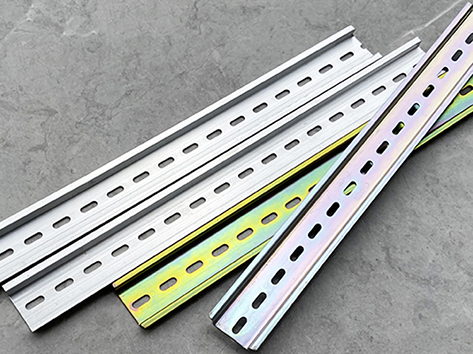
What Is a DIN Rail in Electrical Cabinets?
А DIN-рейка is a standardized metal mounting rail used inside electrical enclosures to securely hold components such as:
Circuit breakers
Terminal blocks
Contactors and relays
Power supplies
Surge protection devices
Control modules
Instead of individually screwing each device into a panel, engineers simply snap components onto the DIN rail, creating a clean and structured layout.
The Role of DIN Rails in Distribution Cabinets
Inside an electrical distribution cabinet, DIN rails act as the backbone of the entire internal structure. Their main roles include:
Механічна підтримка
DIN-рейки provide a strong, stable mounting platform that holds electrical devices securely in place, even in high-vibration environments.
System Organization
They allow components to be arranged in a logical sequence, improving wiring clarity and reducing installation errors.
Electrical Safety Support
Proper spacing and standardized mounting help maintain required clearances between devices, reducing the risk of short circuits or overheating.
Modular Expansion
New devices can be added easily without redesigning the entire cabinet layout.
Why DIN Rails Are So Important
Faster Installation and Assembly
Traditional mounting methods require drilling, screws, and custom positioning. DIN-рейки simplify this process:
Snap-on installation
Reduced wiring time
Less manual alignment work
This significantly improves production efficiency for cabinet manufacturers.
Improved Maintenance and Troubleshooting
Electrical distribution systems often require upgrades or repairs. DIN rail systems allow technicians to:
Quickly remove faulty components
Replace devices without rewiring the full system
Perform maintenance safely and efficiently
This reduces downtime in industrial and commercial environments.
Better Use of Space
Distribution cabinets often contain dense electrical systems. DIN rails enable:
Compact vertical stacking of devices
Optimized wiring routing
Reduced cabinet size requirements
This is especially important in modern applications like renewable energy and smart buildings.
Standardization Across Manufacturers
One of the biggest advantages is global compatibility. Devices from different brands can be mounted on the same DIN rail system, including:
Industrial automation components
Power distribution devices
Control system modules
This reduces supply chain complexity and increases flexibility for engineers.
High Mechanical Stability
Despite their simple appearance, DIN rails are engineered for strength:
Resistant to vibration and mechanical stress
Suitable for industrial environments
Long service life under continuous load
This makes them ideal for factories, power stations, and transportation systems.
Common Types of DIN Rails Used in Cabinets
Different cabinet designs require different DIN rail profiles:
TS35 (35mm Top Hat Rail) – the most widely used standard
TS15 (15mm Mini Rail) – used in compact control systems
G-Type Rail – used for heavy-duty or high-load applications
C-Type Rail – used in older or specialized installations
Each type supports different load capacities and installation needs.
Applications in Electrical Distribution Systems
DIN rails are used across nearly all types of electrical distribution cabinets:
Industrial Control Cabinets
Used for PLCs, relays, motor controllers, and automation modules.
Панелі розподілу електроенергії
Support circuit breakers, surge protectors, and power monitoring devices.
Системи відновлюваної енергії
Common in solar combiner boxes and energy storage systems (ESS).
Building Electrical Systems
Used in HVAC control panels, lighting systems, and smart building automation.
How DIN Rails Improve System Reliability
A well-designed DIN rail layout directly improves system performance by:
Reducing wiring errors
Improving airflow inside cabinets
Preventing component overheating
Enhancing system scalability
This leads to fewer failures and longer equipment lifespan.
Future Trends in DIN Rail Systems
As electrical systems become smarter and more compact, DIN-рейки continue to evolve:
Lightweight aluminum alloys for better efficiency
Integrated grounding and shielding designs
Modular smart device compatibility (IoT-ready panels)
Improved corrosion resistance for harsh environments
These innovations ensure DIN rails remain essential in next-generation electrical infrastructure.
FAQ
1. What is the main purpose of a DIN rail?
It provides a standardized mounting system for electrical components inside distribution cabinets.
2. Why are DIN rails used instead of direct mounting?
They simplify installation, improve organization, and allow easy maintenance and expansion.
3. Are DIN rails universal?
Yes. Most electrical devices are designed to fit standard DIN rail profiles globally.
4. What materials are DIN rails made of?
Common materials include galvanized steel, aluminum, and stainless steel.
5. Where are DIN rails most commonly used?
They are widely used in industrial control systems, power distribution cabinets, and renewable energy installations.
--- КІНЕЦЬ ---
 Електронна адреса: [email protected]
  No. 20 Lingyun Road, Dongfeng
Промислова зона, місто Ліуші, Юецін
Місто, провінція Чжецзян


© Copyright 2024 China Haitan Electromechanical Technology Co., Ltd. Усі права захищено.ЗА ПІДТРИМКУ:JUNJ Політика конфіденційності
 Ukrainian
  English (United States)
  English (South Africa)
  Arabic
  Belarusian
  Bengali
  Japanese
  Kazakh
  Korean
  Myanmar
  Russian
  Thai
Thai  Uzbek
Uzbek  Vietnamese
  Chinese