
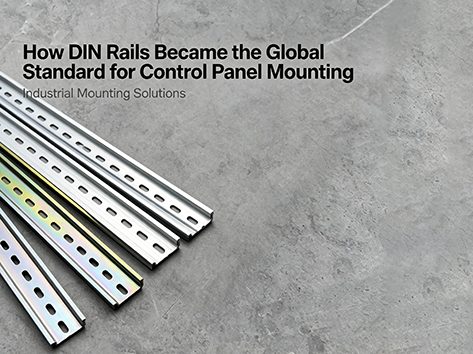
How DIN Rails Became the Global Standard for Control Panel Mounting
Introduction
In modern electrical engineering, efficiency, modularity, and safety are essential design principles. One small but critical component that supports all three is the DIN rail. Today, DIN rail systems are used worldwide as the universal standard for mounting electrical and control devices inside panels—but this was not always the case.
So how did DIN rails become the global standard for control panel mounting? The answer lies in standardization, industrial growth, and the increasing need for flexible electrical system design.
What Is a DIN Rail?
A DIN rail is a standardized metal rail used for mounting electrical components such as:
Circuit breakers
Relays
Terminal blocks
Power supplies
PLC modules
Control devices
The name “DIN” comes from the German standards organization Deutsches Institut für Normung (DIN), which originally defined the rail system for industrial use.
The most common type today is the 35mm top-hat rail, widely used in control cabinets and distribution boards.
The Origins of DIN Rail Standardization
DIN rails originated in Germany in the early 20th century as part of efforts to standardize industrial electrical installations.
Before standardization:
Each manufacturer used different mounting systems
Control panels were difficult to assemble and maintain
Replacement parts were not interchangeable
Maintenance required custom engineering solutions
To solve these issues, DIN introduced a unified mounting rail system that allowed components from different manufacturers to fit on the same structure.
This was a turning point in industrial electrical design.
Why DIN Rails Became a Global Standard
Universal Compatibility
One of the biggest reasons for global adoption is cross-brand compatibility.
Devices from different manufacturers can be mounted on the same rail without modification, making system integration much easier for engineers and installers.
Modular System Design
DIN rails enabled a shift toward modular control panels, where components can be:
Added easily
Removed quickly
Replaced without rewiring the entire system
This modularity significantly reduces installation time and maintenance costs.
Space Efficiency in Control Cabinets
As industrial systems became more complex, space inside control panels became a premium resource.
DIN rail mounting allows components to be arranged:
Vertically or horizontally
Compactly in rows
With optimized wiring paths
This leads to smaller, more efficient cabinet designs.
Faster Installation and Maintenance
Compared to traditional screw-mounted systems, DIN rail mounting offers:
Tool-free or minimal-tool installation
Quick component replacement
Reduced wiring complexity
This is especially important in industries where downtime is costly.
Strong Mechanical Stability
Despite being simple in design, DIN rails provide:
High load-bearing capacity
Vibration resistance
Long-term structural reliability
This makes them suitable for industrial environments such as factories, transportation systems, and energy infrastructure.
Types of DIN Rails
Although the 35mm top-hat rail is the most common, several standardized profiles exist:
35mm Top Hat Rail (TS35) – most widely used in control panels
15mm Mini Rail – used in compact devices
G-Type Rail – used for heavy-duty industrial applications
C-Type Rail – older standard, still used in some regions
Each type is designed for specific load and installation requirements.
DIN Rails in Modern Electrical Systems
Today, DIN rails are used across nearly every industry involving electrical control systems:
Industrial Automation
Used for PLC systems, relays, and industrial controllers.
Renewable Energy
Common in solar combiner boxes and energy storage systems.
Building Infrastructure
Found in HVAC systems, lighting control panels, and building automation.
Transportation
Used in rail systems, electric vehicles, and signaling control panels.
The Role of DIN Rails in Industry 4.0
As manufacturing evolves toward smart factories and Industry 4.0, DIN rails continue to play a key role.
They support:
Modular IoT control systems
Rapidly reconfigurable automation panels
Integration of sensors and smart controllers
Even in highly digital environments, the physical standardization of DIN rails remains essential.
Why DIN Rails Will Remain Relevant
Despite advances in electronics and miniaturization, DIN rails remain widely used because they offer:
A mature global standard
Strong ecosystem support
High flexibility and scalability
Cost-effective system design
In short, they solve a mechanical problem that digital innovation alone cannot replace.
FAQ
1. What is the purpose of a DIN rail?
A DIN rail provides a standardized mounting platform for electrical and control components inside panels.
2. Are DIN rails universal?
Yes. DIN rails follow international standards, making them compatible with most manufacturers worldwide.
3. What materials are DIN rails made of?
They are commonly made from galvanized steel, aluminum, or stainless steel depending on the application.
4. Where are DIN rails commonly used?
They are used in industrial automation, power distribution, renewable energy systems, and building control systems.
5. Why are DIN rails so popular?
Because they simplify installation, reduce costs, and allow flexible system design.
--- END ---
 E-mail: [email protected]
  No. 20 Lingyun Road, Dongfeng
Industrial Zone, Liushi Town, Yueqing
City,Zhejiang Province


© Copyright 2024 China Haitan Electromechanical Technology Co., Ltd. All rights reserved.SUPPORT BY:JUNJ Privacy Policy
 English (South Africa)
  English (United States)
  Arabic
  Belarusian
  Bengali
  Japanese
  Kazakh
  Korean
  Myanmar
  Russian
  Thai
Thai  Ukrainian
  Uzbek
Uzbek  Vietnamese
  Chinese