
Corrosion Resistance in DIN Rails: Materials and Surface Treatments
Introduction
DIN rails are essential components in electrical cabinets, industrial automation systems, renewable energy equipment, and power distribution panels. While they are often viewed as simple mounting structures, their long-term reliability heavily depends on one critical factor: corrosion resistance.
In humid, chemical, coastal, or outdoor environments, corrosion can weaken DIN rails, reduce mechanical stability, and compromise the safety of electrical systems. This is why selecting the right material and surface treatment is essential for modern electrical infrastructure.
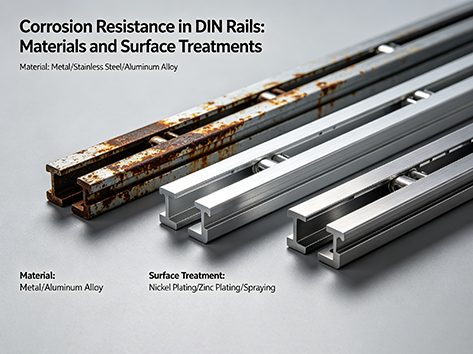
Why Corrosion Resistance Matters in DIN Rails
DIN rails are continuously exposed to environmental factors such as:
Moisture and humidity
Salt spray in coastal areas
Industrial chemicals
Temperature fluctuations
Dust and pollutants
Without proper protection, corrosion may lead to:
Structural weakening
Poor grounding continuity
Difficult maintenance and component replacement
Reduced service life of electrical cabinets
For critical systems, corrosion can even increase the risk of electrical failure.
Common Materials Used for DIN Rails
Different DIN rail materials provide different levels of corrosion resistance and mechanical performance.
Galvanized Steel DIN Rails
Galvanized steel is the most widely used DIN rail material due to its balance of cost and durability.
Advantages
Good mechanical strength
Affordable and widely available
Moderate corrosion resistance
Limitations
Zinc coating may degrade over time in harsh environments
Not ideal for highly corrosive or outdoor conditions
Best Applications
Indoor control panels
Commercial electrical cabinets
General industrial environments
Stainless Steel DIN Rails
Stainless steel DIN rails provide superior corrosion resistance and long-term durability.
Advantages
Excellent resistance to rust and chemicals
Suitable for humid and outdoor environments
Long service life
Limitations
Higher material cost
Heavier than aluminum options
Best Applications
Coastal installations
Chemical plants
Food processing facilities
Renewable energy systems
Aluminum DIN Rails
Aluminum DIN rails are lightweight and naturally corrosion-resistant.
Advantages
Lightweight design
Good oxidation resistance
Easy machining and installation
Limitations
Lower mechanical strength than steel
Less suitable for heavy loads
Best Applications
Lightweight control cabinets
Transportation systems
Compact automation equipment
Surface Treatments That Improve Corrosion Resistance
In addition to base materials, surface treatment technology plays a major role in extending DIN rail lifespan.
Zinc Plating
Zinc plating creates a protective barrier against moisture and oxidation.
Features
Cost-effective protection
Common in standard industrial DIN rails
Improves indoor corrosion resistance
Limitations
Limited durability in extreme conditions
Electrogalvanizing
Electrogalvanized DIN rails use an electrochemical process to create a uniform zinc coating.
Advantages
Smooth surface finish
Better appearance
Improved resistance compared to untreated steel
Common Uses
Commercial electrical panels
Industrial automation systems
Hot-Dip Galvanizing
This process immerses steel in molten zinc to create a thicker protective layer.
Advantages
Strong corrosion resistance
Suitable for harsh industrial conditions
Long-lasting protection
Best Applications
Outdoor electrical installations
Utility infrastructure
Passivation Treatment
Passivation improves the protective oxide layer on stainless steel surfaces.
Benefits
Enhanced corrosion resistance
Better chemical stability
Reduced surface contamination
This treatment is especially important in food-grade and pharmaceutical environments.
Powder Coating
Some DIN rails receive powder-coated finishes for additional environmental protection.
Advantages
Improved moisture resistance
Enhanced appearance
Additional insulation protection
Limitations
Coating damage may expose metal underneath
Environmental Factors to Consider
Choosing corrosion-resistant DIN rails depends heavily on the installation environment.
Humid Indoor Environments
Recommended:
Electrogalvanized steel
Stainless steel for long-term reliability
Coastal Areas
Recommended:
Stainless steel DIN rails
Hot-dip galvanized finishes
Chemical Plants
Recommended:
High-grade stainless steel
Passivated surfaces
Outdoor Solar and Energy Storage Systems
Recommended:
Corrosion-resistant stainless steel
UV-resistant surface coatings
How Corrosion Affects Electrical Safety
Corrosion is not only a cosmetic issue. It can directly affect:
Mechanical support stability
Grounding performance
Connection reliability
Cabinet maintenance efficiency
Severe corrosion may loosen mounted devices or increase resistance at grounding points, creating potential safety risks.
Maintenance Tips for Longer DIN Rail Lifespan
To maximize service life:
Inspect cabinets regularly for rust or coating damage
Keep moisture levels controlled
Avoid mixing incompatible metals
Use proper grounding practices
Select materials based on environmental conditions
Preventive maintenance significantly reduces replacement costs.
Future Trends in Corrosion-Resistant DIN Rails
As industries demand longer-lasting and more sustainable electrical systems, DIN rail technology continues to evolve:
Advanced anti-corrosion alloy materials
Eco-friendly coating technologies
Lightweight high-strength composites
Improved outdoor durability for renewable energy systems
These innovations are helping DIN rails meet the demands of smart infrastructure and harsh operating environments.
FAQ
1. Which DIN rail material has the best corrosion resistance?
Stainless steel offers the highest corrosion resistance, especially in humid or chemical environments.
2. Are galvanized DIN rails suitable for outdoor use?
Standard galvanized rails may work in mild outdoor environments, but harsh conditions usually require stainless steel or hot-dip galvanized options.
3. Why is surface treatment important for DIN rails?
Surface treatments protect the metal from oxidation, moisture, and chemical exposure, extending service life.
4. Can corrosion affect electrical safety?
Yes. Corrosion can weaken mechanical stability and impact grounding reliability.
5. What is the best DIN rail for coastal applications?
Stainless steel DIN rails are generally the best choice for coastal and high-salt environments.
--- END ---
 E-mail: [email protected]
  No. 20 Lingyun Road, Dongfeng
Industrial Zone, Liushi Town, Yueqing
City,Zhejiang Province


© Copyright 2024 China Haitan Electromechanical Technology Co., Ltd. All rights reserved.SUPPORT BY:JUNJ Privacy Policy
 English (United States)
  English (South Africa)
  Arabic
  Belarusian
  Bengali
  Japanese
  Kazakh
  Korean
  Myanmar
  Russian
  Thai
Thai  Ukrainian
  Uzbek
Uzbek  Vietnamese
  Chinese